Gabapentin vs Natural Supplements for Neuropathy
Quick Answer: Is gabapentin or a supplement better for nerve pain?
For diabetic nerve pain, current evidence favours gabapentin: a recent randomised trial found it outperformed B-vitamin combinations across measures, supporting it as a first-line prescription option. B-vitamins are a lower-side-effect, low-cost adjunct, not a replacement. Supplements are complementary support; any decision about medication belongs with your own clinician.
- Effectiveness: gabapentin has the stronger trial evidence for symptom relief.
- Tolerability & cost: B-vitamins are cheaper and gentler, but with smaller effects.
- The honest framing: adjunct, not alternative — and never a self-managed swap.

If you have searched "gabapentin vs natural supplements", you are almost certainly weighing two very different things against each other: a prescription drug designed to quiet overactive nerve-pain signalling, and a group of nutrients marketed to support nerve health more broadly. It is a fair question, but a fair answer has to resist the temptation to declare a simple winner. The honest version is that they play different roles, the evidence behind them is not equal, and the right choice is personal and clinical — not something a webpage should decide for you.
What gabapentin is, and what the trials show
Gabapentin is a prescription medication commonly used for nerve-related pain, including painful diabetic peripheral neuropathy. It works on the nervous system to reduce the abnormal signalling that produces burning, shooting and tingling sensations. It is one of the more established options a clinician can reach for, and its evidence base in randomised trials is comparatively deep.
A recent head-to-head randomised controlled trial sharpened the picture. It compared gabapentin against a B-vitamin approach — combinations of B1, B6 and B12, and B12 on its own — in people with diabetic neuropathy. Across the trial's outcome measures, gabapentin came out ahead, showing greater improvement than the vitamin arms. That result reinforces what treatment guidelines already tend to say: for troublesome diabetic nerve pain, a medication like gabapentin is a reasonable first-line choice, while vitamins, on their own, produced more modest changes.
It is worth being precise about what that does and does not mean. "Outperformed vitamins in a trial" is a statement about relative symptom relief in one population, not a claim that gabapentin cures anything or that vitamins are worthless. Both statements would be wrong.
What "natural supplements" actually covers here
The supplement side of this comparison is broad and uneven. The best-supported members are specific nutrients: B12, especially where a deficiency is contributing to nerve problems; the wider B-complex; and, separately, compounds such as alpha-lipoic acid, which has its own randomised-trial history in diabetic neuropathy. Beyond those, "nerve support" formulas often add botanicals with much thinner human evidence for this particular use. Lumping all of that together as "supplements" flatters the weakest ingredients and undersells the strongest, so it helps to keep the categories separate in your head.
The genuine appeal of the nutrient approach is not that it beats a drug. It is that, for the right person, it can offer gentle, low-risk, low-cost support — and that correcting a real deficiency (a B12 shortfall, for instance) is not optional wellness but a legitimate fix for a real cause.
The trade-offs, side by side
Choosing between, or combining, these options comes down to trade-offs rather than a scoreboard. Here is the shape of them.
| Factor | Gabapentin | B-vitamins / nutrient support |
|---|---|---|
| Trial-backed pain relief | Stronger; first-line evidence | Smaller, less certain effects |
| Access | Prescription only | Over the counter |
| Common downsides | Drowsiness, dizziness, swelling, dose titration | Generally well tolerated; excess B6 has its own risk |
| Cost | Varies; often covered | Typically inexpensive |
| Best role | Managing significant nerve pain | Correcting deficiency; complementary support |
Gabapentin's strength is effectiveness; its cost is a side-effect profile that some people find hard to live with, plus the need for a prescription and careful dose adjustment. The nutrient approach flips that: fewer and milder side effects and easy access, but smaller and less reliable benefit. Neither column is "better" in the abstract — the better option is the one that fits your symptoms, your other conditions and your tolerance for side effects.
A note on B6 within the "vitamin" option
One caveat inside the supplement column deserves flagging: more B-vitamin is not automatically better. Vitamin B6 in particular can, at high doses over long periods, cause its own sensory neuropathy. So the "gentle and low-risk" description holds only when doses stay sensible. That is a reason to read labels and avoid stacking high-dose products, not a reason to avoid B-vitamins altogether.
Adjunct, not alternative
The most useful way to frame the relationship is that supplements are best understood as complementary support alongside proper care, not as a replacement for a medication that is working. Many people do take B-vitamins while on a prescription, and the two are not mutually exclusive. What they should not do is quietly stop a prescribed drug and hope a supplement fills the gap — that swaps a better-evidenced option for a weaker one without medical oversight.
If you are drawn to the supplement route because of gabapentin's side effects, the right move is to say exactly that to your prescriber. There may be dose changes, alternative medications, or a combined plan that keeps you comfortable. Those are clinical decisions with real consequences, which is precisely why they belong in a consultation rather than a checkout cart.
How gabapentin is used in practice
Understanding how gabapentin is actually prescribed helps explain why the comparison is not really apples-to-apples. It is typically started low and increased gradually — a process called titration — to find a dose that balances relief against side effects. That slow build is deliberate: it reduces the drowsiness and dizziness that are most pronounced early on, and it lets the prescriber and patient calibrate together. Gabapentin is also not the only prescription option in this space. Clinicians choosing a medication for painful diabetic neuropathy commonly weigh gabapentinoids (gabapentin and pregabalin) against agents such as duloxetine and certain tricyclic antidepressants like amitriptyline. Guidelines generally treat several of these as reasonable first-line choices, with the pick tailored to a person's other conditions, medications, sleep, mood and side-effect tolerance. A supplement simply does not sit on that same shelf of options, which is the point of framing it as complementary rather than competing.
Why B-vitamins still earn a place
None of this makes the nutrient side pointless. B-vitamins keep a legitimate role for a few concrete reasons. The most important is deficiency correction: if a genuine B12 shortfall is contributing to nerve symptoms — something more common in older adults, in people on long-term metformin or acid-suppressing drugs, and in those eating little animal protein — then replacing it is not "alternative medicine", it is fixing a real cause. Beyond that, B-vitamins are inexpensive, widely available and generally well tolerated, which makes them a low-stakes adjunct that some people and clinicians add alongside standard care. The honest limit is that, as a stand-alone therapy for established nerve pain, their measured effects in trials are smaller than a drug like gabapentin. Adjunct value and first-line value are two different claims, and only the first is well supported for vitamins here.
Do not forget the underlying cause
One theme gets lost in "drug versus supplement" debates: neither is a substitute for addressing why the nerves are struggling in the first place. In diabetic neuropathy, for example, steady blood-sugar management is central to the long game, and lifestyle factors — movement, alcohol moderation, foot care, sleep — all feed into how nerves fare over time. A medication can make day-to-day symptoms more bearable and a nutrient can support the background, but the durable work often lies in the underlying condition. Viewing gabapentin, supplements and cause-management as parts of one plan, rather than rivals, tends to serve people better than picking a single hero.
Questions worth bringing to your clinician
If you are weighing these options, a short list of questions turns a web search into a productive appointment:
- Given my symptoms and other conditions, is a medication like gabapentin appropriate, or would another first-line option suit me better?
- Have we checked for a correctable cause, such as a B12 deficiency or blood-sugar control?
- If I want to add a supplement, are there interactions with what I already take?
- What side effects should prompt me to call you, and how should any medication be adjusted rather than stopped abruptly?
Cost, access and the real-world picture
Effectiveness is only one axis of a real decision; people also live with cost, access and how a choice fits their day. Gabapentin needs a prescription and a period of dose-finding, and its side effects — drowsiness, dizziness, occasional swelling — are the price some pay for its stronger relief. B-vitamins and similar nutrients are cheap, easy to obtain and gentle, which is genuinely why they remain popular as an adjunct, even though their measured effects are smaller. This is where the recent trial evidence is most useful: it does not tell you which option to pick, but it does tell you not to expect a vitamin to do a drug's job. A cost-effective, low-side-effect supporting role is a fair description of B-vitamins; a like-for-like replacement for gabapentin is not. Holding both of those truths at once is what an honest comparison looks like — and it is why the final call belongs to you and your clinician together, not to a search result.
What the numbers behind gabapentin actually look like
Gabapentin is usually described either as a proven treatment or as an overprescribed sedative, and neither caricature survives contact with the data. The 2017 Cochrane review of gabapentin for chronic neuropathic pain in adults pooled the randomised evidence and found that, at 1,800 to 3,600 mg a day, a minority of people achieve substantial pain relief — roughly a third or fewer — with adverse events including dizziness, somnolence, peripheral oedema and unsteadiness occurring considerably more often than on placebo. It works well for some people and does nothing for many, which is why prescribing is a trial rather than a prescription-and-forget.
The head-to-head picture is more useful than the placebo one. The OPTION-DM randomised trial compared the main pathways used in painful diabetic neuropathy and found broadly similar average efficacy across them, with the practical advantage lying in combination and in switching when the first drug fails. A wider 2025 systematic review and meta-analysis in Lancet Neurology reached the same broad conclusion: modest average benefit, meaningful variation between individuals.
Why "natural alternative" is the wrong frame
Supplements and neuropathic pain drugs are not competing for the same job. Gabapentin does nothing to the underlying nerve damage; it dampens the pain signalling. The nutrients with any evidence behind them, chiefly alpha-lipoic acid, also modify symptoms rather than repair nerves — but with smaller measured effects and shorter trials. Neither addresses the cause, which is why the evidence-led sequence puts glucose control, deficiency correction and exercise first.
Two practical points. Gabapentin should not be stopped abruptly, and dose changes belong with the prescriber; it is also renally cleared, so reduced kidney function changes dosing. And because sedation is one of its more common effects, the interaction with sleep is worth planning deliberately — our page on nerve pain and sleep covers the non-drug half of that. For chemotherapy-related nerve pain the recommended pathway differs again, and our review of chemotherapy-induced neuropathy options sets out what the guideline supports. If you want each ingredient graded rather than grouped, our evidence survey of nerve-health supplements does that comparison directly.
Medical note: this article is general information, not medical advice, and nothing here is a recommendation to start, stop or change any medication or supplement. Gabapentin should not be discontinued abruptly. Discuss your symptoms, your full medication and supplement list, and any changes with a qualified healthcare professional before acting.
Scientific references
- Wiffen PJ, et al. Gabapentin for chronic neuropathic pain in adults (Cochrane Database of Systematic Reviews, 2017)
- Tesfaye S, et al. Optimal pharmacotherapy pathway in adults with diabetic peripheral neuropathic pain: the OPTION-DM RCT (Health Technology Assessment, 2022)
- Soliman N, et al. Pharmacotherapy and non-invasive neuromodulation for neuropathic pain: a systematic review and meta-analysis (Lancet Neurology, 2025)
- Pop-Busui R, et al. Diabetic Neuropathy: A Position Statement by the American Diabetes Association (Diabetes Care, 2017)
- Mayo Clinic — Peripheral neuropathy: diagnosis and treatment
- NINDS — Peripheral Neuropathy Information Page
Frequently asked questions
Is gabapentin more effective than vitamins for neuropathy?
In the current evidence, yes, at least for diabetic nerve pain. A recent randomised controlled trial found gabapentin outperformed B1-B6-B12 combinations and B12 alone across its outcome measures, which supports gabapentin as a first-line prescription option. Vitamins showed smaller effects, so they are better understood as supportive rather than equally powerful.
Can supplements replace gabapentin?
No. Supplements should not be treated as a substitute for a prescribed medication. B-vitamins and other nutrients may offer modest, lower-side-effect support, but the trial evidence does not show them matching gabapentin for nerve pain. If a medication is working, stopping it in favour of a supplement is a decision only your clinician should guide.
What are the trade-offs of each option?
Gabapentin tends to be more effective but can cause drowsiness, dizziness, swelling and dose adjustments, and it needs a prescription. B-vitamins and similar supplements are inexpensive and generally well tolerated, but their effects are smaller and less certain. The right balance depends on symptom severity, other health conditions and personal preference, weighed with a clinician.
Can I use supplements alongside gabapentin?
Often people do, and B-vitamins are commonly used as an adjunct. Even so, combining anything with a prescription medication should be cleared with your doctor or pharmacist first, because of possible interactions and the need to correct a genuine deficiency properly. Tell your clinician every supplement you take so the whole plan is coordinated.
Related reading
Considering a nutrient adjunct? Start with the label
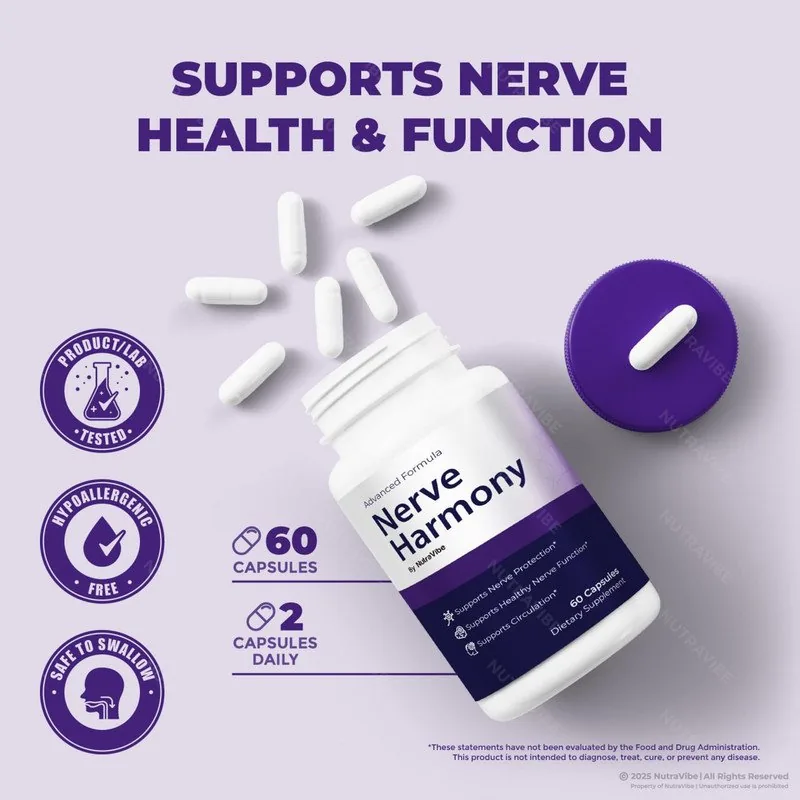
See what Nerve Harmony contains, what the evidence supports, and the current pricing — then talk it through with your clinician.